
ECONOMIC & FIXED INCOME COMMENT- Wait and See

The global economy entered 2026 stronger than many anticipated, supported by strong investment in artificial intelligence, supportive financial conditions and easing trade tensions. However, the conflict in the Middle East has become the dominant force shaping the global economic outlook. Energy prices and the costs of other essential agricultural and industrial inputs originating from the Persian Gulf economies have significantly increased due to production and export curtailments. The confluence of higher energy, agricultural, and industrial input prices, along with the potential for renewed central bank tightening, is contributing to a modestly weaker global outlook. Despite these challenges, the global economy is forecast to expand 2.8% in 2026.

Policymakers globally are confronted with challenging decisions as central banks balance the supply-driven rise in prices against the risk of weakening growth. North America has demonstrated remarkable resilience amidst the disruption caused by the Middle East conflict, outperforming many regions. As net energy exporters, Canada and the U.S. have largely avoided the most severe impacts of the closure-driven shock to the Strait of Hormuz.
The U.S. economy is anticipated to experience another robust year of growth, with economists maintaining their GDP growth forecast of 2.1% for 2026. The continuous advancement of artificial intelligence infrastructure remains a key driver of growth, while the labour market has demonstrated signs of stabilization. The Federal Reserve held the policy rate steady at 3.75% for a fourth consecutive meeting and adopted a more hawkish stance under Kevin Warsh, with updated economic projections showing upward revisions to both the Core Personal Consumption Expenditures Inflation rate and the Median projection for the Federal Funds rate.

Recent economic data for the Canadian economy has presented a mixed outlook. GDP contracted by 0.1% in the first quarter, marking the second consecutive quarter of negative growth and meeting the technical criteria for a recession. However, per-capita GDP increased, household consumption remained robust, and early indications suggest a potential recovery in growth. While the Canadian economy is on track to break its technical recession, growth will remain below trend through 2026 due to slower population growth, tariff-related pressures on export demand, and weaker business and consumer confidence. Overall, the Canadian economy is projected to expand 1.0% in 2026 and will be influenced by the CUSMA/USMCA trade negotiations.
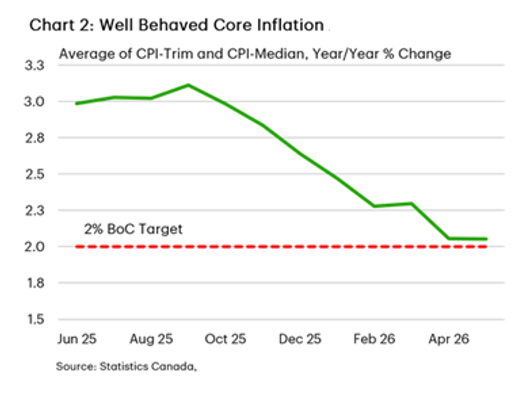
The Bank of Canada maintained its overnight rate at 2.25% for the fifth consecutive meeting, acknowledging slower economic momentum, a weakening labour market, and potential inflationary pressures stemming from the Middle East conflict. Given the ongoing underperformance of the Canadian economy and the anticipated normalization of global energy and agricultural inputs, core inflation is expected to remain relatively contained. The Canadian economy remains more rate-sensitive due to higher household leverage and frequent mortgage resets, raising the hurdle for further tightening. Against this backdrop, Canadian bonds, particularly in the short to intermediate segments, remain attractive due to their yields and potential for capital appreciation if economic growth does not meet expectations.


Comments